

Bicultural, Biracial, and multicultural identity therapy in NYC for people who are done shapeshifting to belong.
Too foreign for home.
Too foreign for here.
Never enough for both.
You understand this feeling even if you've never had the words for it.
There's a version of you for your family, one for your friends, one for work. You've been switching between them so long you're not sure which one is actually yours anymore.
You grew up between identities that never fully overlapped. Cultures, races, languages, expectations that shifted depending on the room. Maybe that meant translating between two languages at home, or being the only one in your family who looked the way you did, or never knowing which box to check. You got good at reading people and adapting yourself, but it never quite fit right.
There was something at home that nobody on the outside could see. A parent who stopped speaking their language to you, or a family that just never talked about the parts of you that didn't match them. Either way, you carry a grief for a connection to your heritage you were never given the chance to build.
People who love you say things like "I don't see color" or "you're just my kid" and don't understand why that makes it worse. It tells you the thing you feel every single day is invisible to the people closest to you.
It's not in your head.


It shows up everywhere. Not just in how you see yourself.
This isn't just about identity in the abstract. It weaves into your anxiety, your relationships, your career, and the way you move through the world every day.
-

In your family.
Love and loyalty are so tangled you can't tell them apart. Choosing something for yourself feels like a betrayal, whether that's pushing back on what your family expects, claiming a part of your identity they'd rather not talk about, or simply wanting to be seen for all of who you are.
-
In your relationships.
You shapeshift to please people. You over-give, over-accommodate, lose yourself. And then you wonder why closeness never feels safe. Secure attachment is hard to build when you haven't felt settled in your own skin.
-

In your mental health.
Anxiety and burnout weren’t taken seriously growing up. You were told to stop worrying and try harder. So you did. And you kept trying until the exhaustion caught up with you.
-
In your sense of self.
You feel like you're not enough of any one thing to claim it. Not Black enough, not white enough. Not Latina enough, not American enough. Whatever your specific version is, you've been editing yourself depending on the audience so long you forgot what the unedited version looks like.
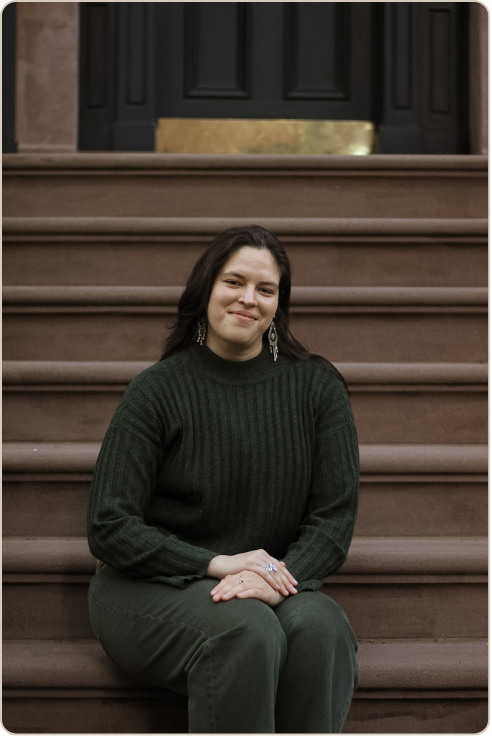
I understand this work because I've been in it myself.
I'm biracial and bicultural, the daughter of a Peruvian mother and an American father, Brooklyn born. Ni de aquí, ni de allá. Neither here nor there.
I grew up staring at checkboxes that didn't hold all of me. Code-switching through every room and carrying shame for parts of my identity I couldn't control. In high school I sat in the back of Spanish class terrified someone would hear me struggle and doubt my latinidad. I still carry that one sometimes.
At home, my grandmother told me bedtime stories in Spanish. My mom spoke to me in English because she was trying so hard to assimilate. I was angry with her for not connecting me to my heritage while she was working through her own version of the same thing in the opposite direction. Nobody on the outside saw any of it.
In college I couldn't find a group that held all of me, so I started one. The MUTTS club. Multicultural Understanding To Transform Stereotypes. Total dorky sociology major move, but I was so proud of it. And the relief of finally being in a room where I didn't have to translate my experience was like nothing I had ever felt before.
That relief is what I want you to feel when you walk through my door. There is no language to translate this experience other than living it yourself, and I've lived it. That understanding is the center of who I am and how I practice.
What therapy for bicultural, biracial and multicultural identity actually looks like
This isn't about picking a culture or resolving your identity into a tidy narrative. The goal isn't a finished self. It's an ongoing, honest relationship with a self that keeps evolving.
✦ Exploring the in-between without pressure to "figure it out." Pride and shame and confusion can all exist at the same time.
✦ Sorting out which parts of your identity feel chosen and which ones feel like they were assigned to you.
✦ Setting boundaries with family without it feeling like betrayal or a rejection of where you come from.
✦ Making sense of how other people's perceptions of you shape your sense of self, especially when those perceptions change room to room.
✦ Working through the exhaustion of always being the one who translates, explains, or educates.
✦ Understanding how your identity shapes everything else, your anxiety, your relationships, your perfectionism, your burnout.
✦ Being seen as a whole person, all of it, not just the parts that are easiest to explain.
You don't have to shape-shift here.
You don't have to check a box.
Put it all down and show up as you are. It will all make sense in time.
Questions about bicultural identity therapy
-
No. This work is for anyone navigating the complexity of holding multiple cultural and racial identities. First and second-generation Americans, third-culture kids, people adopted across cultures, anyone who grew up between worlds and feels the weight of that.
-
That feeling is exactly what we work with. You don't need to prove your identity is "valid enough" to deserve support around it. If it takes up space in your head, it belongs in this room.
-
No. Integration, not erasure. The work is about finding a relationship with all parts of your identity that feels honest, not about picking one over the other.
-
That's incredibly common, and it's something we can talk about too. Wanting therapy isn't a betrayal of where you came from. It's one of the most courageous things you can do with the opportunities your family fought for.
-
I've lived it. The shapeshifting, the guilt, the checkbox that doesn't hold all of you. I'm not approaching this from a training module. I'm approaching it from personal experience, clinical depth, and the belief that your cultural context is never an afterthought. It's the center of the work.