
Attachment and relationship therapy in NYC for people who are tired of repeating the pattern.
You keep choosing the same kind of love. And it’s not a coincidence.
You want closeness. You crave it. And the second it gets close, something in you shuts down.
You fall hard, then pull away. You chase someone, feel everything, and the moment they actually show up for you, suddenly you feel nothing. You want to be seen and heard and understood but when someone tries, it feels unsafe so you withdraw. You go quiet. You convince yourself you don’t care.
Or you go the other direction. You open up, let someone in, and a lukewarm response hits like rejection. A slow text reply spirals into abandonment. You read into everything because you’ve learned that the people closest to you are the ones who can hurt you the most.
You want to be close but you’re terrified they’ll one day leave you for someone better, so your actions come out disjointed, confusing, sometimes even cruel. And then you hate yourself for it. You used to hate being vulnerable in front of anyone. Maybe you still do. Maybe you’ve gotten so good at performing closeness that nobody realizes you’re not actually letting them in.
You hold everyone together. You’re the reliable one. Nobody thinks to ask what you need because you’ve never let them see that you need anything at all.
These aren’t personal failures. They’re patterns. And they started long before your last relationship.
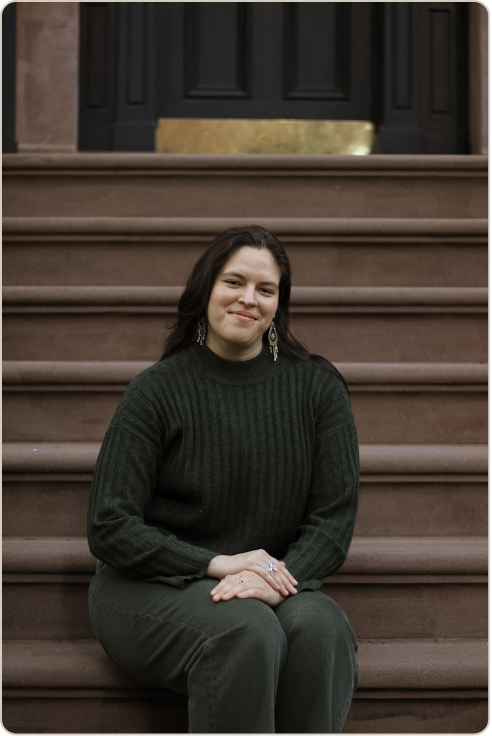
I understand this work because I've been in it myself.
I'm biracial and bicultural, the daughter of a Peruvian mother and an American father. My mom gave everything to build a life here. Love in my family looked like sacrifice, like working nonstop, like never complaining, like always reaching for more because rest wasn't something she trusted. My dad's love was different. Devoted, close, protective in a way that left little room for me to learn how to steady myself. He wanted to be everything I needed, and I learned to stay tuned to him, reading the room, anticipating, making myself useful when things felt shaky.
Between the two of them, I picked up two lessons about love that never quite fit together. That needing something from someone meant you were being selfish, so the strong one just carries it and keeps going. And that closeness was safety, and staying needed was how I kept it.
I brought all of that into every relationship I've ever had. The over-giving, the shapeshifting to keep people comfortable, the quiet fear that if someone actually saw the full messy version of me they wouldn't stick around. I didn't know how to ask for what I needed because I never learned that was an option.
I became a relational therapist because I know what it feels like when the way you love doesn't match what you actually need. When closeness feels like a risk you can't afford. When your family loved you deeply and devotedly and it still wasn't the kind of love that taught you how to feel safe. I know what it's like to not have the words for that yet.
I learned this from living it and from doing my own work, and from sitting with hundreds of clients who carry their own version of the same thing.

Your attachment patterns didn't just show up out of nowhere.
They were shaped inside your family, inside your culture, inside systems that taught you what love is supposed to look like and what you’re allowed to ask for.
-

If you grew up in a collectivist family,
closeness and interdependence were how your family loved. But a partner or even a therapist might call that enmeshed or codependent. It’s not. It’s a different way of relating. And it doesn’t need to be fixed.
-
If you’re the child of immigrants,
love probably looked like sacrifice. Your parents showed up by working three jobs, not by asking how your day was. And now you’re in adult relationships where you know how to give everything but have no idea how to ask for what you need.
-

If you grew up in a family where feelings just weren’t discussed,
that distance didn’t have to come from immigration to leave a mark. Maybe stoicism was how your family survived. Maybe emotions were seen as weakness or inconvenience. Maybe nobody in your house ever named what they felt so you never learned how either, and now you’re in relationships where someone asks you what’s wrong and you genuinely don’t know how to answer.
-
If you grew up between cultures,
your attachment style probably doesn’t fit neatly into one box. Maybe you’re anxious in some relationships and avoidant in others depending on which version of yourself feels safe to show. That’s not inconsistency. That’s what happens when you’ve had to adapt your whole life just to belong.
-
If you're in an interracial or intercultural relationship,
you already know that love comes with different rulebooks. What closeness looks like, how conflict gets handled, what family involvement is normal, how emotions get expressed or don't. You're not just learning each other, you're learning each other's entire cultural wiring around intimacy. And when those wires cross, it can feel like you're speaking different languages about the things that matter most.
-
If your family was separated by migration,
that disruption lives in your body whether you remember it or not. The way your parents loved, the way they couldn't, the stress they carried. All of it got passed down alongside the suitcases.
The way you love and the way you struggle in love makes complete sense when you see the full picture.
Not just your last breakup.
Your whole story.
What we actually work on
Understanding your pattern. Not just naming it anxious or avoidant, but getting into why it developed, what it was protecting, and how your family and culture shaped the way you learned to love.
Connecting it to where it started. Your parents, your family system, the cultural rules about love and gender and emotion. We look at how all of that shows up in your relationships right now.
Noticing it in real time. These patterns don't just live in your stories about past relationships. They show up between us in the room too. That's where the real shifts happen.
Building something different. Not a formula for healthy relationships. A deeper understanding of yourself inside of them. So you can stop performing closeness and actually feel it.
Questions about attachment and relationship therapy
-
My main focus is individual work, but I'm definitely open to couples, especially those in interracial or intercultural relationships. Sometimes people come in because of a specific relationship and we absolutely get into that. Whether it's individual or couples work, the deeper stuff is always about understanding the patterns you carry and how they show up in the people you love.
-
Yes. When you understand where a pattern started and what it's protecting, you create space to respond differently. It doesn't happen overnight. But it happens. And it tends to shift everything.
-
Some of the most powerful attachment work happens outside of a relationship. You can focus entirely on yourself without the noise of a current dynamic.
-
That's exactly what we hold here. A lot of what gets labeled as "anxious attachment" or "codependency" is actually a culturally coherent way of relating that doesn't need to be fixed. It needs to be understood. We figure out what's cultural, what's protective, and what's no longer serving you.
-
That's usually the question that unlocks everything.
The pattern makes sense. And it can change.
You don't have to keep choosing the same kind of love to understand why you do.